
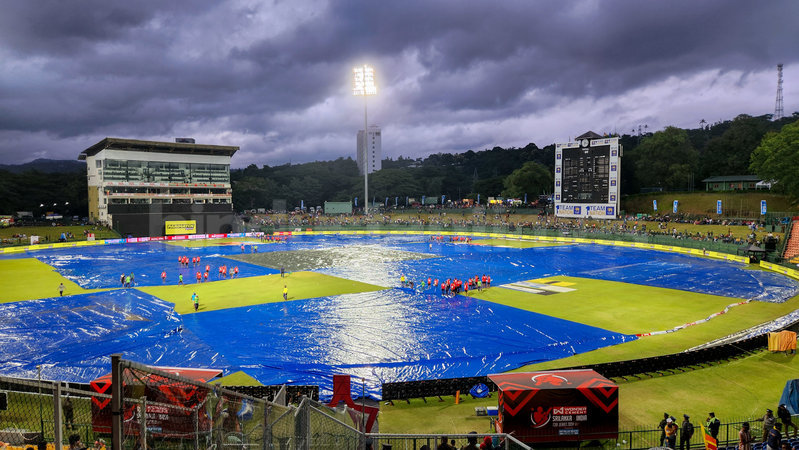
Rain delays are a frequent occurrence in the game of cricket. As always, adjustments to the playing conditions are required to make play possible. But resumption comes with a set of revised conditions. While we earlier addressed how overs are calculated during a rain interruption, the DLS method in cricket is used to calculate a revised target in rain-affected limited-overs matches. The DLS rules and DLS formula work together to ensure that both teams are treated as fairly as possible after play has been interrupted. Also known as the Duckworth Lewis Stern method, this ground-breaking innovation first came into existence in 1997.
English statisticians Frank Duckworth and Tony Lewis collaborated closely to formulate the DLS method in cricket. This was done in an effort to eliminate obvious pitfalls left behind by the erroneous Average Run Rate (ARR) and the Most Productive Overs (MPO) methods that often lacked fairness while calculating the revised target. Unlike the earlier two methods, the DLS formula in cricket not only takes runs and wickets into account, but also considers the wickets, which impact a team’s ability to score runs.
After being formally inducted into the ICC rules in 1999, the DLS method in cricket remained a mystery and largely evaded public view. But after successful integration with the ICC’s broader cricketing ecosystem, the DLS rule in cricket serves as an indispensable component of the game. In this article, we will highlight what is the DLS formula in cricket all about and how targets are revised in a rain affected game.
Table of Contents
DLS Method In Cricket: Understanding The Core Concept
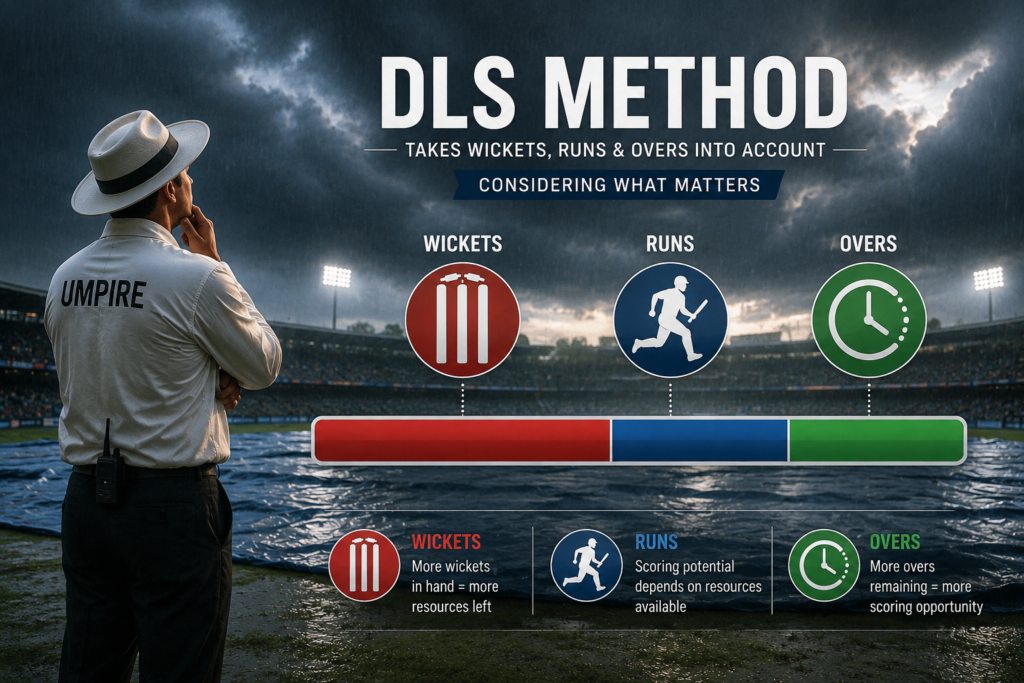
The DLS method in cricket operates on the principle that a batting side possesses two key scoring resources at the start of an innings. They are as follows:
- Overs Left
- Wickets In Hand
The quantity of these resources depends on the format being played. In One Day Internationals, a team begins with 50 overs (300 balls) and 10 wickets, whereas in T20 cricket, the allocation is reduced to 20 overs (120 balls) while the wicket count remains unchanged.
As an innings progresses, both resources gradually diminish. A team may consume all of its allotted overs or lose all 10 wickets before reaching the scheduled end of the innings. The DLS formula in cricket accounts for this continuous depletion of resources when determining revised targets in rain-affected matches.
Simply reducing a target based on overs lost would not produce a fair outcome. The scoring potential of a team depends heavily on how many wickets remain at the time of an interruption. For example, a side that is 25 overs into its innings with only two wickets down is in a far stronger position than a team at the same stage that has already lost six or seven wickets. By considering both wickets and overs together, the DLS method in cricket calculates a revised target that more accurately reflects each team’s remaining scoring opportunities.
DLS Rules In Cricket: Basic Criteria & Real-Time Application

To better understand how the DLS method in cricket works, it is important to look at the situations in which it is applied. The Duckworth–Lewis–Stern system is designed exclusively for rain-affected limited-overs matches and only comes into effect when play has already commenced. Its primary purpose is to ensure that interruptions caused by weather do not unfairly advantage either side.
For a revised target to be calculated in an ODI, the team batting second must have the opportunity to face a minimum of 20 overs. In T20 cricket, the threshold is lower, with at least 5 overs required in the second innings for a result to be possible under DLS regulations. If these minimum requirements are not met, the match may be declared a no result.
DLS calculations are carried out using specialized software operated by an ICC-appointed official. The software applies the official DLS formula by evaluating overs remaining, wickets in hand, and available resources before calculating a revised target. These DLS rules ensure that rain interruptions do not unfairly benefit either side. Whenever play is interrupted, the system evaluates the resources available to both teams by considering factors such as overs remaining and wickets in hand. Once the first innings has been completed, the software uses the runs scored, overs bowled, and wickets lost to determine a revised target for the chasing side.
By comparing the resources available to each team at various stages of the match, the DLS method produces a target that is both balanced and statistically fair.
DLS Method in Cricket: Understanding Key Terminologies (Resources, Par Score, Target)
Before getting a broader understanding of the DLS method in cricket and how the DLS formula works, let’s familiarize ourselves with the fundamental DLS method concepts, as indicated below in the table:
| Terminology | Explaination |
| Resources | Resources = overs remaining + wickets in hand. A team starts with 100% resources, which gradually reduce as overs are bowled and wickets fall. |
| Par Score | It’s the score the chasing team should have reached after completing X overs in relation to X wickets lost. |
| Revised Target | The revised target is the score the team batting second must chase after a rain interruption. It is adjusted based on the resources available to both teams, including overs remaining and wickets lost. |
| Interruption | Refers to a break in play which can be caused in the event of rain delay or non-weather-related circumstances. |
💡 Note Below: These concepts form the foundation of the official DLS guidelines used to determine revised targets in rain-affected matches.
Breakdown Of DLS Method In Cricket Formula
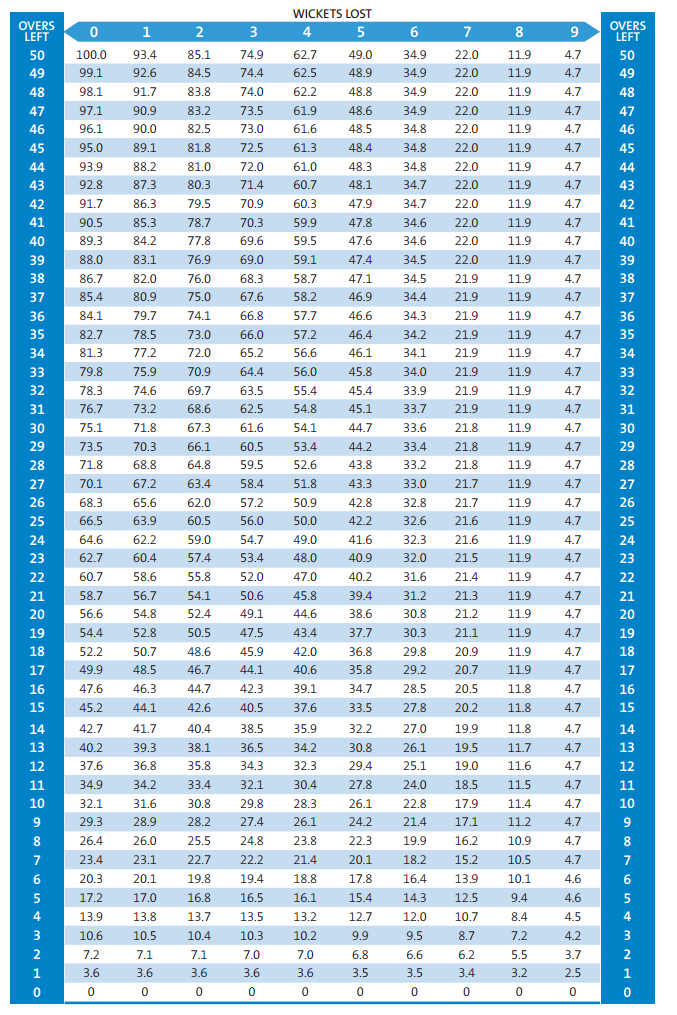
The DLS method is built around a simple concept: the scoring potential of a batting side depends on the resources it has available. In cricket, these resources are measured using two factors—overs remaining and wickets in hand. Every team begins an innings with 100% of its resources available, whether that is 50 overs and 10 wickets in an ODI or 20 overs and 10 wickets in a T20 match.
As the innings progresses, resources gradually decline as overs are consumed and wickets fall. If a team is bowled out or completes its full allocation of overs, its resources are considered fully exhausted. However, rain interruptions can prevent a team from utilizing all of its available resources, reducing its ability to score runs.
To account for this, the DLS method calculates the percentage of resources available to both teams at different stages of the match. These values are stored in official DLS tables and software, which are then used to determine a revised target for the side batting second. The revised score reflects not only the first innings total but also the relative resources available to both teams after the interruption.
DLS Calculator Formula
Team 2 Target = Team 1 Score × (Team 2 Resources ÷ Team 1 Resources)
Although the mathematical equation appears straightforward, the official DLS formula in cricket relies on resource percentages generated from extensive statistical modelling rather than a simple runs-per-over calculation. This is why international matches use ICC-approved DLS software instead of manual calculations.
Since the calculated target may not always be a whole number, it is rounded up to the next highest run. The score immediately below the revised target becomes the par score. If the chasing team finishes exactly on the par score, the match is tied. Any score above the revised target results in a win for the team batting second.
Real-Time Application of DLS Calculator Formula
This practical example also demonstrates how DLS works in cricket, with the software recalculating targets based on both overs remaining and wickets in hand rather than overs alone. Many cricket fans are curious about how the DLS method actually calculates revised targets during rain-affected matches. At its core, the system revolves around the concept of resource allocation. As discussed earlier, a batting side’s scoring potential is determined by two primary resources: overs remaining and wickets in hand.
The calculation process comes into effect whenever play is interrupted by rain or other unforeseen delays. At each interruption, the DLS system assesses the resources still available to the batting team by referring to an official resource table. This table is based on historical scoring data and modern batting trends, assigning resource percentages according to the number of overs remaining and wickets lost. These percentages are then used to determine how much scoring potential each team has retained, allowing a revised target to be calculated in a fair and consistent manner.
| 1 | Evaluate resources consumed by Team A | Use the resource table to determine the percentage of resources consumed by Team A. Example: Team A used 100% resources to score 270 runs in 50 overs. (If they batted 20 overs for 2 wickets, resources consumed = ~32.7%.) | Team A used 100% resources to score 270 runs in 50 overs. (If they batted 20 overs for 2 wickets, resources consumed = ~32.7%). |
| 2 | Evaluate resources left for Team B | After the interruption, calculate the overs lost and use the resource table to determine the resources remaining based on overs left and wickets in hand. | If Team B’s run chase is truncated to 30 overs with 10 wickets intact, they have 75.1% resources left. |
| 3 | Perform DLS target calculation | Apply the formula: Multiply Team A’s score by Team B’s resources left, divided by the resource percentage of Team A. | Revised Target: 270 × 75.1 / 100 = 202.77 (Rounded up to 203 in 30 overs) |
Limitations & Criticism Surrounding DLS Method In Cricket

The DLS method in cricket is a sophisticated statistical system designed to produce fair outcomes in rain-affected matches. By factoring in both overs remaining and wickets in hand, it attempts to accurately measure a team’s scoring potential when interruptions occur.
Despite being the internationally accepted standard, the DLS method has often attracted criticism from players, commentators, and fans alike. Some of its most commonly cited drawbacks include:
Disadvantage for teams batting first: Another criticism of the DLS method is that it can sometimes favor the team batting second. A rain interruption may prevent the side batting first from fully utilizing its overs, while the chasing team benefits from knowing the revised target and having all 10 wickets available to plan its chase accordingly.
Reduced focus on overs instead of wickets: Critics have often argued that the DLS method places too much emphasis on wickets in hand compared to balls remaining. As a result, a team scoring at a slower run rate could occasionally benefit from preserving wickets. However, this concern was largely addressed through revisions introduced in 2015.
Lack of emphasis on fielding restrictions: One of the major criticisms of the Duckworth–Lewis–Stern (DLS) method is that it does not directly account for fielding restrictions. Much like wickets in hand, field placements can have a substantial impact on a team’s scoring potential. Batters are generally able to score more freely during powerplay overs when only a limited number of fielders are permitted outside the inner circle.
Before a revised DLS target can be calculated, officials must first determine the reduced number of overs available. You can learn more about this process in our guide to Over Calculation in Rain-Affected Matches.
What are the DLS rules in cricket?
The DLS rules in cricket are used to calculate a revised target whenever a limited-overs match is interrupted by rain or other unforeseen circumstances. The Duckworth–Lewis–Stern (DLS) method considers two key resources—overs remaining and wickets in hand—to ensure that both teams have an equal opportunity to compete. These official DLS rules are applied in both One Day Internationals (ODIs) and T20 matches.
What is the DLS formula in cricket?
The DLS formula in cricket calculates a revised target by comparing the batting resources available to both teams. Instead of simply reducing the target according to overs lost, the formula also considers wickets in hand because they directly influence a team’s scoring potential. The official DLS calculation is performed using ICC-approved software based on established resource tables rather than manual calculations.
How does the DLS method work in cricket?
The DLS method works by assigning each team a percentage of batting resources based on the number of overs remaining and wickets lost. Whenever rain interrupts play, the system compares the resources available to both teams and uses this information to calculate a revised target. This approach helps ensure that rain-affected matches remain as fair as possible.
Is the DLS method used in the IPL?
Yes. The Indian Premier League (IPL) follows the same Duckworth–Lewis–Stern (DLS) method approved by the ICC whenever rain interrupts a match. The DLS rules in the IPL are identical to those used in international limited-overs cricket, with revised targets calculated using official DLS software based on overs remaining and wickets in hand.
What are the minimum overs required for the DLS method?
For the DLS method to produce a result, the team batting second must face a minimum of 5 overs. This approach is also consistent with the DLS method IPL is used to follow these days. If these minimum overs requirements under DLS (a.k.a IPL DLS rules) are not met, the match is usually declared a No Result.
Related Post on Rain Interruptions in Cricket