



Rain, rain, rain…please go away! We all have been there, haven’t we? When there is a rain delay in cricket, over reduction occurs. It’s as simple as that. In other words, it is understood that compromises have to be made either way in unavoidable events like these. In essence, that is what the rain rules in cricket are all about. During every rain delay in cricket, umpires must decide how many overs need to be reduced, whether the innings should continue, and what the revised cut-off time should be.
That has essentially been the rule of thumb for several decades. To make up for the lost time, over reduction ensures play concludes within the stipulated time frame. However, there is more to it. Did you ever wonder how over calculation is performed in case of a rain delay under the rain rules in cricket? And how over reduction is performed with respect to time lost? To understand how the cricket rain delay rules are applied in rain interrupted cricket match, we will have to take a trip back in time.
Back in the good old days, the over rate used to be 4 minutes per over. Thanks to the sluggish nature of the game in those days, teams were expected to complete at least 1 over in every 4 minutes. In other words, 1 over would be retracted for every 4 minutes of playing time lost. But as the game evolved, so did the formats, and the governing body was left with no choice but to revise the cricket rain rules to keep things relevant. The ICC needed a standardized way to perform over reduction in a rain interrupted match in cricket across formats. In other words, the ODI cricket rain rules and the T20 cricket rain rules had to be consistent format-wise. This requirement led to the rise of the over rate concept, which we will be addressing very shortly in our cricket rain delay rules guide.
In this article, we will debunk all the mysteries surrounding cricket rain delay rules, how over calculations are performed in real time during a particular stage of the match, and guide you step-by-step on how to input values using the calculation tables. Let’s jump right in!
Over Rate Variations in Cricket (All Formats)
In a nutshell, an over rate is the amount of time consumed to bowl an over. It is usually calculated in minutes. The over rate regulations vary across formats and differ across gender categories as highlighted below.
Over Rate Regulations (Men’s Cricket)
| Format | T20I | ODI |
| Over Rate | 4.25 minutes/over | 4.2 minutes/over |
According to ODI cricket rain delay rules for the men’s category, the current over rate for ODI cricket is 4.2 minutes per over. Whereas, under T20 rain delay rules, the window gets extended ever so slightly to 4.25 minutes per over. However, that is only the case if no drinks interval is taken. Some playing conditions, such as the IPL and SA20, allow intervals to be taken during a T20 innings, which makes the over rate 4.5 instead of 4.25 minutes per over.
Over Rate Regulations (Women’s Cricket)
| Format | T20I | ODI |
| Over Rate | 3.75 minutes/over | 3.8 minutes/over |
As for ODI rain delay rules in women’s cricket, the over rate margins are a lot narrower. With short run-ups and smaller boundary dimensions, ladies can rush through their overs far more quickly than men do. As a result, the one day rain rules in cricket for the ladies are a lot more relaxed. The over rate for the women’s category is truncated to 3.75 & 3.8 overs/minute in T20 & ODI cricket, respectively.
Over Calculation Tables (Applicable for ALL interruptions from 1st to 2nd innings)
So is it really that simple to merely reduce 1 over for every 3-4 overs lost? The answer is no! Why? Simply because there could be an endless number of situations in rain interrupted cricket match. A rain interrupted match in cricket does not have a fixed time of occurrence. Interruption could occur before the start of play, or at some point during the first or second innings. Furthermore, rain could also halt proceedings just before a scheduled break. The list goes on.
Therefore, to address this complex requirement, umpires these days are equipped with over calculation sheets, allowing them to approach the problem more scientifically. These over calculation sheets contain 4 main tables. These tables help umpires calculate overs, revised session timings, powerplay guidelines, and overs/bowler. Furthermore, these tables can also be applied at any level of the game, whether it is amateur cricket or professional cricket comparable to international standards. The over calculation sheet tables can be applied across all formats of the game (except multi-day) and stay pretty much the same for men’s and women’s cricket. Remember, the sheet format remains consistent even at the highest level of the game. Only the manner in which we update the missing fields changes.
| Table No | Purpose |
| 1 | To be used when an interruption occurs during the first innings or before the start of play. |
| 2 | Only to be used to determine whether the first innings is to be terminated while performing over calculation. |
| 3 | To be used for over reduction in the second innings in case the first innings is to be terminated |
| 4 | When an interruption occurs solely during the second innings |
Top Tip: In reality, most umpires at club level spend much of their time performing calculations on Table 1 & 4 ONLY.
Table 1: Interruption During First Innings
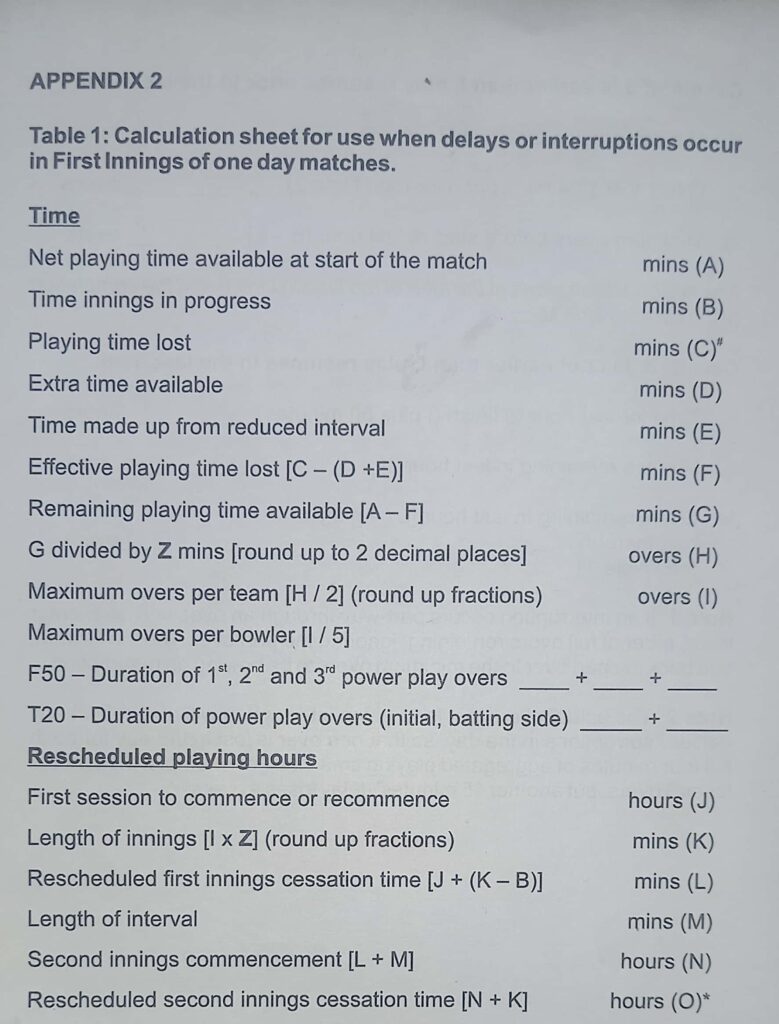
This is how Table 1 of the over calculation sheet looks. We will walk you through the process of updating the missing fields by running live match simulations.
A: (Men’s ODI: 420, Women’s ODI: 380, Men’s T20: 170, Women’s T20: 150)
B: Enter the amount of time spent during play (In minutes)
C: Enter the total interruption time (In minutes)*
D: Refer to your playing conditions to learn whether extra time is allowed or not*
E: This again varies according to playing conditions. Time (in minutes) can be taken out of the interval to make up for lost playing time.*
F: [C-(D+E)]
G: A-F
H: G/Overs per minute (Men’s ODI: 4.2, Women’s ODI: 3.8, Men’s T20: 4.25, Women’s T20: 3.75)
I: H/2 & I/5 to determine overs/bowler
J: Enter your revised resumption time
K: I x overs/minute
L: [J+(K-B)]
M: Adjusted interval duration
N: L+M
O: N+K
*Playing time lost is always cumulative. If there are multiple interruptions, the time lost for every delay will be added while doing the next over calculation. Extra time may or may not be available depending on your playing condition. Enter 0 if no extra time is permitted.
Match Example: Let’s take an example of a rain interrupted match in cricket under BCCI plang conditions. The start of a BCCI List-A game has been delayed by 90 minutes. The game was meant to begin at 9 AM. But due to a 90-minute rain delay in cricket, the game could only resume at 10:30 AM. Calculate the revised overs, match timings, powerplay overs, and overs/bowler.
A: 420
B: 0 (No play took place before interruption)
C: 90
D: 0
E: 15 (Interval is 45 minutes as per BCCI PC. If interval is truncated to 30 minutes then we get 15 minutes back)
F: [90 – (0+15)] i.e. 75
G: [420-75] i.e. 345
H: 345/4.2 i.e. 82.14 to be ALWAYS rounded up to 83
I: 83/2 i.e. 41.5 or 42 overs
Overs per bowler: 42/5 => 4 bowlers to bowl 8 overs + 1 bowler to bowl 10 overs
Powerplay overs: Refer to the powerplay table
J: 10:30 AM
K: 42×4.2 i.e. 176.4 or 177 minutes
L: [10:30 + (177 – 0) i.e. 1:27 PM
M: 30 minutes
N: 1:27+30 i.e. 1:57 PM
O: 1:57+177 i.e. 4:54 PM
| Parameters | Result |
| Revised overs | 42 overs/side |
| Revised Timings (1st innings) | 10:30 AM – 1:27 PM |
| Interval | 1:27 PM – 1:57 PM |
| Revised Timings (2nd innings) | 1:57 PM – 4:54 PM |
Table 2: Interruption During First Innings (Termination of innings)
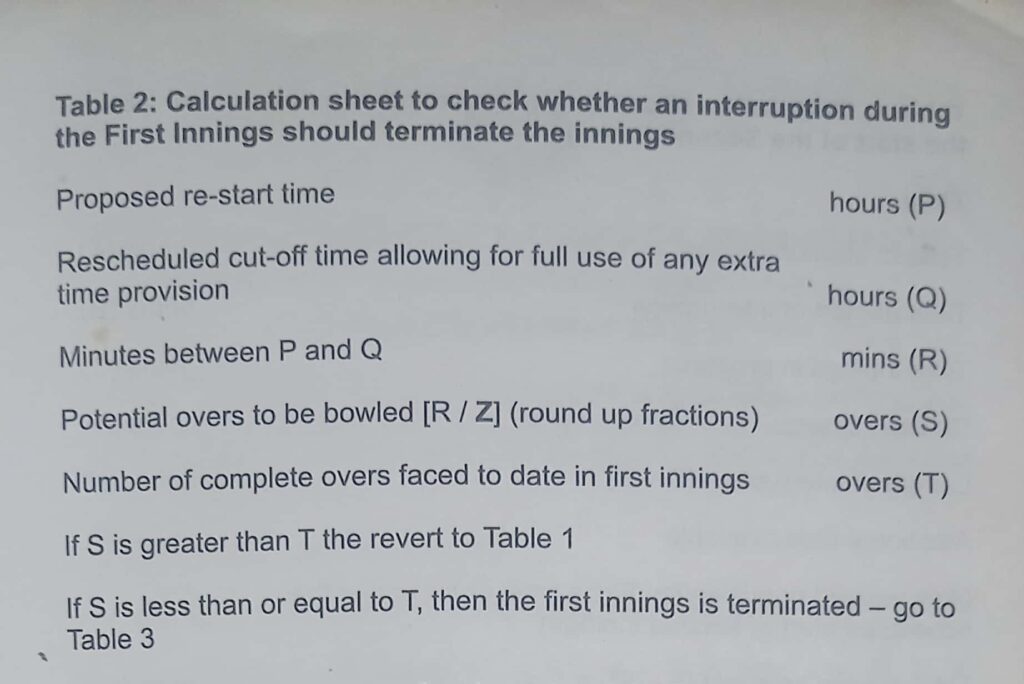
Here is how Table 2 of the over calculation sheet looks. This table is only to be used to determine whether the interruption in the first innings was long enough to terminate that innings. We will walk you through the process of updating the missing fields by running live match simulations.
P: Enter your proposed restart time
Q: Enter your original cessation time (if extra time is N/A) on its own, or enter the combined value merging original cessation time and extra time
R: Difference in minutes between P & Q
S: R/Z (Overs per minute)
T: If S > T revert to Table 1. But if S is less than or equal to T, then first innings is terminated and we move to table 3.
Match Example 1: After 36 overs of play from 9 AM onwards, the rain interrupted match in cricket was halted at 12 PM due to rain. It is only possible to resume play at 1:40 PM. Determine whether the first innings needs to be terminated.
P: 1:40 PM
Q: 4:45 PM (That is the cessation time for a List-A BCCI game, and extra time is generally not permitted)
R: (1:40 – 4:45) i.e. 185 mins
S: 185/4.2 i.e. 45 overs after rounding up
T: 36 overs bowled so far
Conclusion: So S (45) is greater than T (36), which means we will revert back to Table 1 and we will resume proceedings from the first innings.
Match Example 2: Let’s refer back to our earlier example. After 36 overs of play from 9 AM onwards, play is halted at 12 PM due to rain. The proposed restart time has been deferred to 3 PM. Determine whether the innings is to be terminated or not.
P: 3 PM
Q: 4:45 PM
R: [3-4:45] i.e. 105 mins
S: 105/4.2 i.e. 25
T: 36 overs bowled so far
Conclusion: So S (25) is less than T (36), which means the first innings will have to be terminated, which will lead us to table 3.
Table 3: Over Calculation Sheet For Second Innings Following Termination
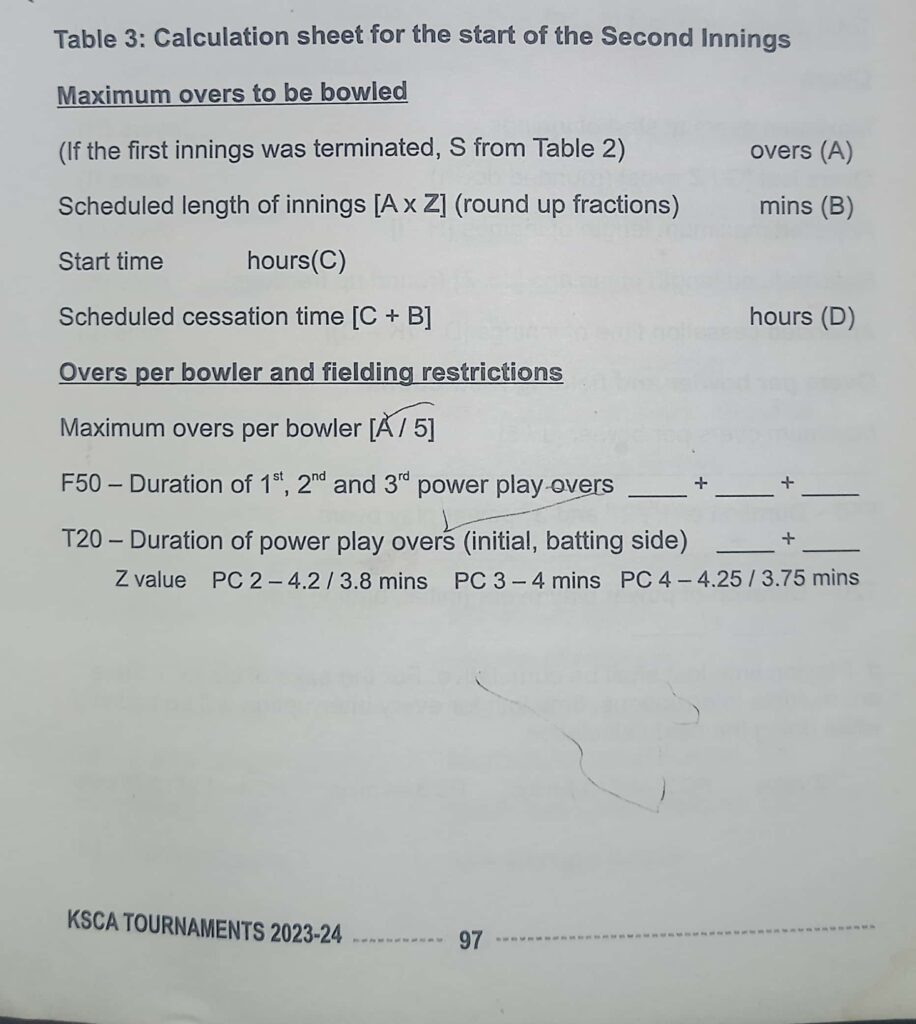
Here is how Table 3 of the over calculation sheet looks. We will continue our illustration process using our earlier example.
A: 25 (S from table 2)
B: AxZ i.e 25 x 4.2 = 105 mins
C: 3 PM (proposed restart time)
D: C+B i.e. 4:45 (3PM + 105 mins)
Conclusion: Second innings is truncated to 25 overs and the session timings are revised to 3 PM – 4:45 PM.
Table 4: Interruption During Second Innings
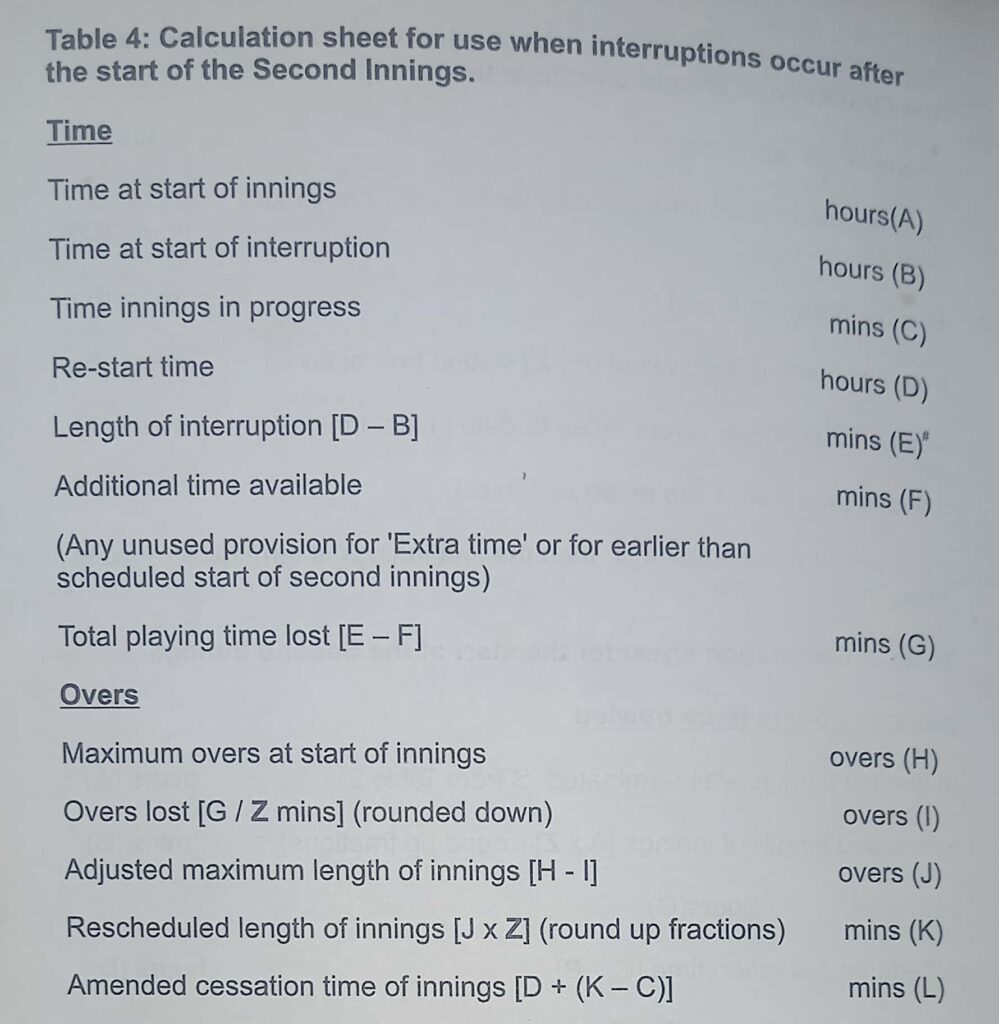
This is how Table 1 of the over calculation sheet looks. We will walk you through the process of updating the missing fields by running live match simulations. This table is only to be used in case of a delay or interruption during second innings.
A: Enter the original second innings start time
B: Enter the time at which interruption occured
C: Playing time during the innings (In minutes)
D: Proposed restart time
E: D-B
F: Unused extra time from first innings or any additional extra time alloted as per PC
G: E-F
H: Enter maximum overs to be bowled at the start
I: G/Overs per minute
J: H-I
K: J x overs/minute
L: [D+(K-C)]
Match Example: Let’s consider a T20 rain interrupted match in cricket from the BCCI. It’a day T20 match and the official timings for the second innings are 11.45 AM to 1.10 PM. Let’s assume the first innings concludes on time, and the 2nd innings gets underway at sharp 11:45 AM. But at 12 PM, rain stops play, and a resumption is only possible at 12:45. Calculate the revised overs, session timings, powerplay conditions, and overs/bowler.
A: 11:45 AM
B: 12 PM
C: 15 mins
D: 12:45
E: 45 mins (D-B)
F: 0 in this case
G: 45 (E-F)
H: 20 overs
I: 45/4.25 i.e. 10.5 rounded down to 10 overs
J: [20-10] i.e. 10 overs
K: J x overs per minute i.e. 42.5 or 43 minutes
L: [12:45 + (43-15)] i.e. 1:13 PM
Overs/bowler: 10/2 = 5 overs per bowler
Powerplay overs: Refer to the powerplay table
| Parameters | Result |
| Revised overs | 10 overs |
| Revised Timings (Post interruption) | 12:45 PM – 1:13 PM |
| Revised Duration | 43 minutes |
FAQs on Over Calculation Sheet
What is Over Calculation Sheet?
An Over Calculation Sheet is designed to assist the umpires in over reduction and revision of match timings in a rain interrupted match in cricket.
What does rain delay mean in cricket?
A rain delay in cricket simply refers to a temporary suspension of play because rain has made conditions unsafe or unsuitable. Depending on the length of the delay, umpires may reduce overs or even abandon the match.
Does the Over Reduction Sheet apply to all levels of cricket?
Yes, the over reduction sheet applies to all levels of cricket, spanning from grassroot amateur level cricket to the international level.
Which are the two main aspects that are considered while performing over reduction?
Time lost and time in play are the two main components that are looked at while using the over calculation sheet.
What is the number to input in the extra time field?
Refer to your playing conditions to find out whether any extra time is permitted. If not, enter 0.
How do we calculate time made up for interval?
Refer to the playing conditions to learn about the allotted interval time. The interval time can be minimized to make up for the lost playing time due to rain delay.
What more inputs can be derived from the Over Reduction Sheet?
Apart from revised overs and match timings, the over calculation sheet also helps the umpires derive powerplay overs and overs/bowler.
Can the over reduction sheet be used for any interruption outside rain delays in cricket?
Yes, the umpires are allowed to use the over calculation sheet to address any form of delay apart from rain.
What’s the over rate and overs/minute for men’s one-day cricket?
The over rate and overs/minute in a men’s one-day (ODI) cricket match are 14.2 & 4.2 overs/minute, respectively.
What’s the over rate and overs/minute for women’s one-day cricket?
The over rate and overs/minute in a women’s one-day (ODI) cricket are 15.78 & 3.8 overs/minute respectively.
How many overs are needed in an ODI if it rains?
Under one day match cricket rain delay rules, a minimum of 20 overs need to be delivered in both innings to constitute a match.
How many overs are needed in a T20 if it rains?
For T20, a minimum of 5 overs needs to be delivered in both innings to constitute a match.
Which format(s) sees the use of Over Calculation sheet?
The use of over calculation sheet is only applicable for limited-overs games featuring one-day and T20 formats.
Last But Not Least: Cut Off Time Calculation For ODIs & T20s
What is cut off time in cricket? The cut off time in cricket is the latest possible time at which play can restart while still allowing the minimum required overs to be completed. The cut-off time differs between T20 and ODI cricket because the minimum overs and over rates are different.
The ODI rain cut off time for T20 match in rain, or the cut off time for ODI match in rain, can easily be calculated by multiplying the minimum overs by the over-rate and later adding a 10-minute innings interval at the end. After deriving the value, we perform the calculation backwards from the original over cut off time.
Here are a few examples below that will break down every single step required to perform the over cut off time calculation for a one-day or T20 game.
Scenario 1: Cut off time for ODI match in rain
| Format | Minimum Overs | Minimum Duration (Full match) | Over Rate |
| One-Day | 20 | 84×2 (168 mins) | 4.2 minutes/over |
Step 1: Refer to your playing conditions (PC) to find out your original cessation time.
Step 2: 20 (minimum overs) x 4.2 (minutes/over in ODI) = 84 minutes
Step 3: Calculate the minimum time needed to complete both innings (84×2 i.e. 168 minutes)
Step 4: Add 10 minutes for innings interval (168+10=178 minutes)
Step 5: Back calculate 178 minutes from your original cessation time.
Scenario 2: Over Cut Off time for T20 match in rain
| Format | Minimum Overs | Minimum Duration (Full match) | Over Rate |
| T20 | 5 | 21.25×2 (43 mins) | 4.25 minutes/over |
Step 1: Refer to your playing conditions (PC) to find out your original cessation time.
Step 2: 5 (minimum overs) x 4.25 (minutes/over in ODI) = 21.25 minutes
Step 3: Calculate minimum time needed to complete both innings (21.25×2 i.e. 42.5 or 43 minutes)
Step 4: Add 10 minutes for innings interval (43+10=53 minutes)
Step 5: Back calculate 53 minutes from your original cessation time.
Closing Thoughts On Performing Over Calculation In A Rain Interrupted Cricket Match

Keeping hold of proceedings during a rain interrupted match in cricket can be a very chaotic affair for the umpires. Not only are you required to monitor the conditions frequently, but you also need to address queries on resumption from players and coaches alike. It’s indeed a tight situation, and with no prior knowledge about over calculations, you create a hole for yourself. Umpires often operate in a high-pressure environment where decisions are tricky and instantaneous, scrutiny is constant, and formal feedback is usually limited.
But the good news is that the over calculation sheet is easy to use and is adjustable to every level of the game and format, excluding multi-day fixtures. With the hope of live match examples, we hope you are able to deploy the over calculation sheet in a scientific manner. When not on the field, it’s advisable that you spend enough time figuring out the over calculation sheet and understand how every step in the over calculation sheet is performed.
More on Rain Interrupted Matches in Cricket




One response to “Rain Delay Rules in T20 & ODI Cricket: How To Perform Over Calculation During Rain Interrupted Match”
[…] TAKE ME THERE […]