

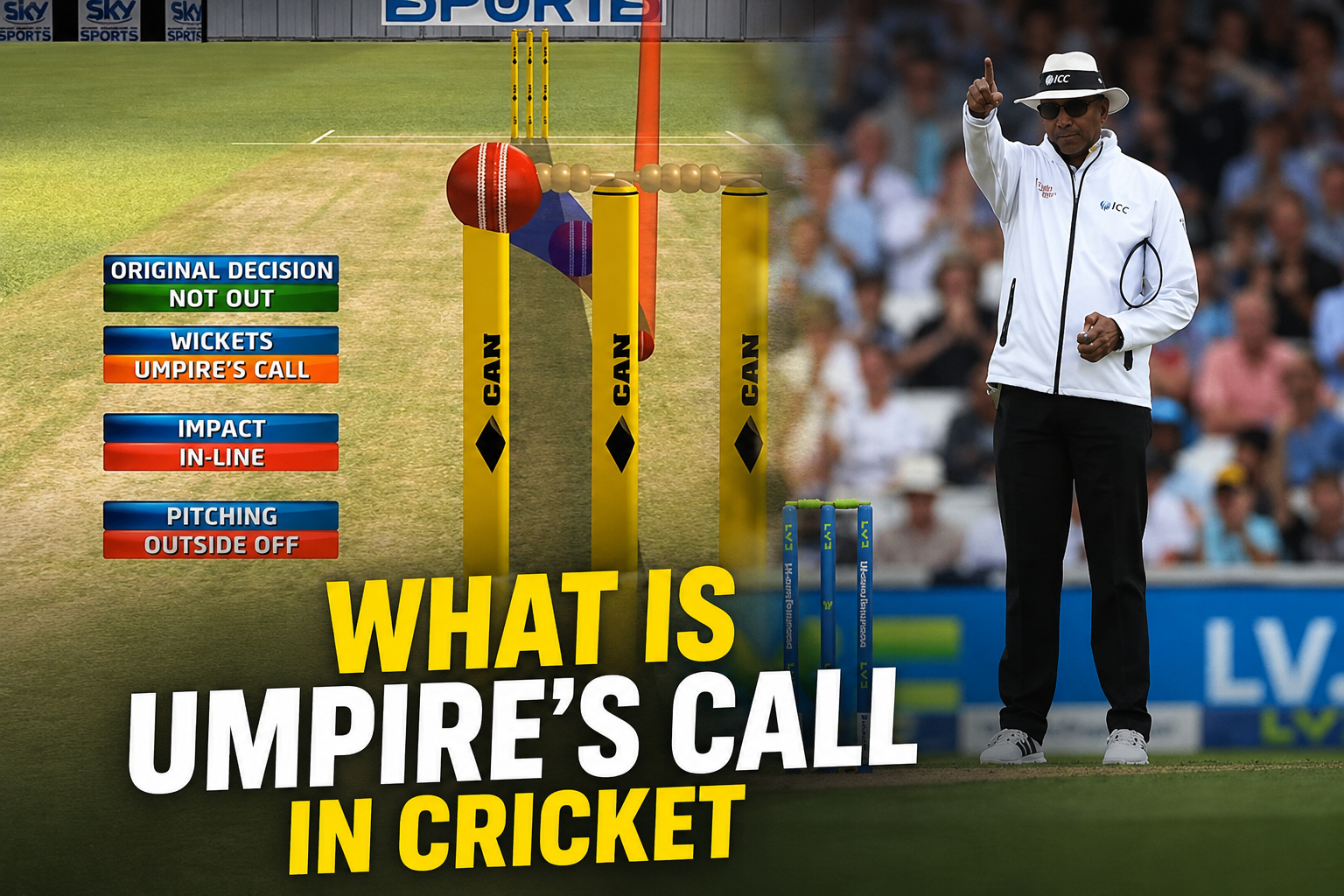
Umpire’s call is one of the most misunderstood aspects of DRS in cricket, particularly when it comes to close LBW decisions. Introduced as part of the Decision Review System (DRS), umpire’s call in cricket exists to preserve the authority and credibility of the on-field umpire when technology cannot deliver a completely definitive answer. While tools such as ball tracking, UltraEdge (Snicko), and Hawk-Eye have significantly improved decision-making, they still have a small margin of uncertainty. In such situations, the original on-field decision remains unchanged if the available evidence is not conclusive enough to overturn it. This approach allows technology to assist umpires rather than replace them, creating a balance between human judgement and modern innovation under the LBW law.
Despite its purpose, the umpire’s call in cricket, often simply referred to as the umpire’s call by fans, has remained one of the most debated aspects of the Decision Review System. Some believe that if technology predicts the cricket ball would hit the stumps, the batter should always be given out, regardless of the original decision. Others argue that retaining umpire’s call is essential to maintain the role and confidence of on-field officials. In this article, we’ll explain what is umpire’s call in cricket, how the rule works alongside DRS, and explore the different scenarios in which umpire’s call can influence the final outcome of an LBW review.
What Is the Meaning of Umpire’s Call in Cricket?
Many fans often ask, “What is the meaning of umpire’s call in cricket?“ Simply put, umpire’s call refers to a situation where the available DRS evidence is not conclusive enough to overturn the original on-field decision. In such cases, the decision made by the umpire remains unchanged. Understanding what is umpire’s call is essential because it highlights that technology is designed to support the umpire rather than replace them altogether.
Historical Context Behind Umpire’s Call in Cricket

The concept of umpire’s call was introduced alongside the Decision Review System (DRS) when it was officially adopted in international cricket in 2009. Since then, umpire’s call in cricket has become one of the most widely discussed aspects of the game’s review system, particularly in contentious LBW decisions. Recognising that ball-tracking technology involves a degree of prediction and that on-field umpires can occasionally make close judgement calls, the ICC introduced umpire’s call to strike a balance between technology and human decision-making.
As a result, the original on-field decision is upheld whenever the available evidence is not conclusive enough to overturn it, such as when ball tracking predicts that less than 50% of the ball is hitting the stumps or when the impact on the batter falls within the marginal umpire’s call zone under the LBW law.
“The principle underpinning DRS was to correct clear errors in the game whilst ensuring the role of the umpire as the decision-maker on the field of play was preserved, bearing in mind the element of prediction involved with the technology. Umpire’s call allows that to happen, which is why it is important it remains.”
Anik Kumble (Former indian Cricketer & Chariman of ICC)
In April, Anil Kumble, then chairman of the ICC Cricket Committee, explained why umpire’s call continues to play such an important role within DRS in cricket, despite advancements in technology:
Since its introduction, umpire’s call has fuelled endless debates across the cricketing fraternity. While players, experts, and fans continue to hold differing opinions on whether the rule is fair, its primary objective remains unchanged and that is to preserve the authority of the on-field umpire while allowing technology to correct only obvious mistakes. To better understand what is umpire’s call in cricket, let’s now examine the three different scenarios in which an umpire’s call is applied under the DRS system.
Umpire’s Call in Cricket: Exploring The Three Zones
Whenever a batter challenges an LBW decision using DRS in cricket, the ball-tracking system analyses the delivery through three separate zones before arriving at the final verdict. These are the Pitching Zone, Impact Zone, and Wicket Zone. Each zone plays a crucial role in determining whether the original decision stands, although the umpire’s call is not applied equally across all three.
1. Pitching Zone
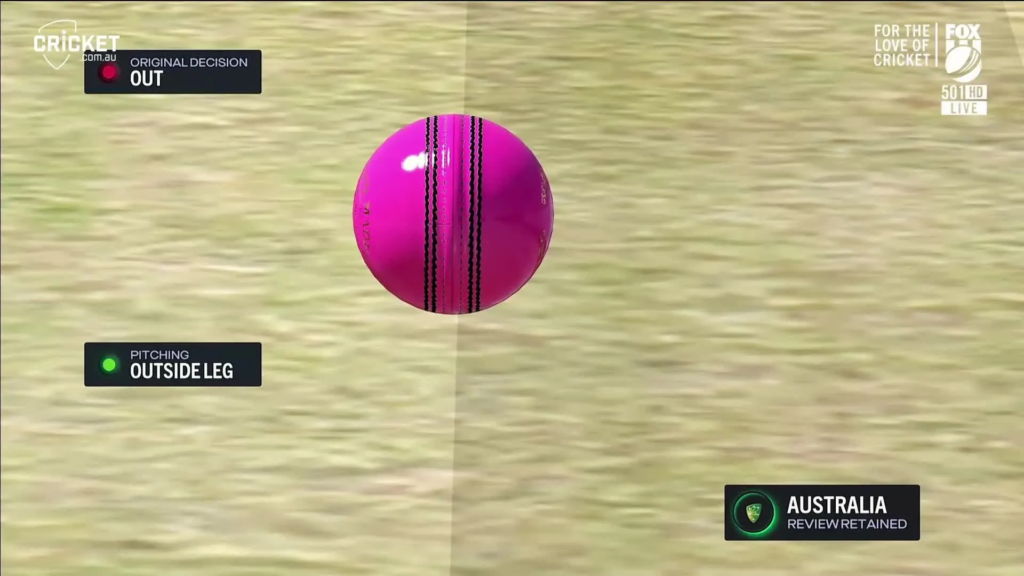
The Pitching Zone determines where the ball first bounces after leaving the bowler’s hand. It is represented by a two-dimensional area running along the length of the pitch, with its boundaries aligned to the outer edges of the stumps at both ends. Unlike the other two zones, umpire’s call is not applicable here because modern ball-tracking technology can accurately identify the exact point where the ball pitched. According to ICC, the cricket ball should always land more than 50% outside the line. As a result, there is no margin for interpretation or uncertainty. The delivery has either pitched in line with the LBW law, outside off stump, or outside leg stump.
2. Impact Zone
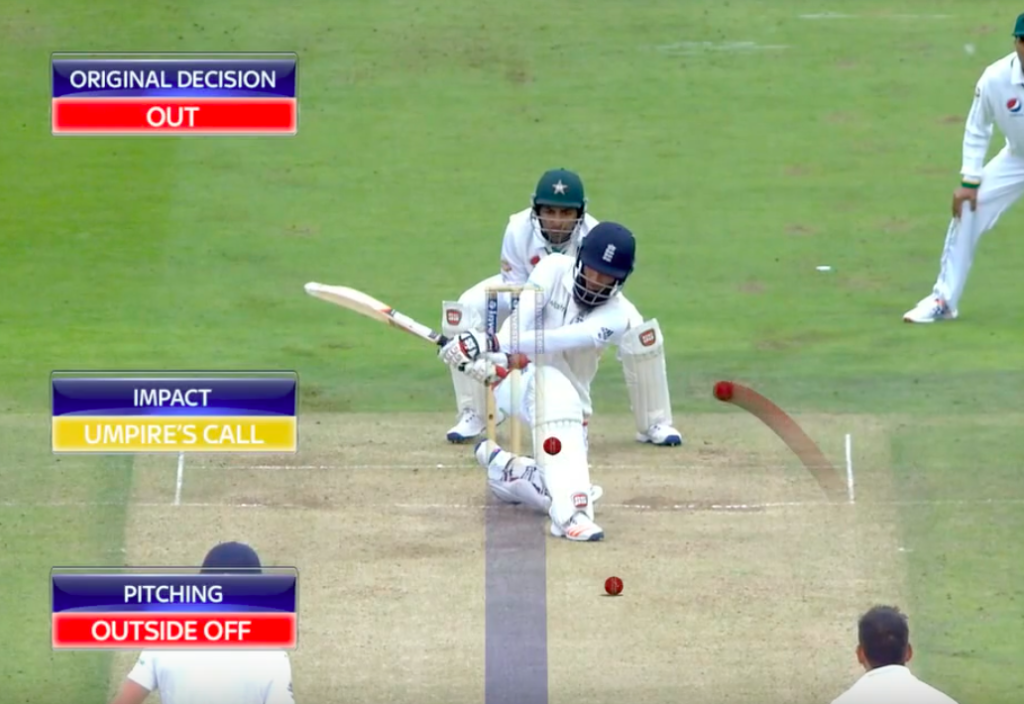
The Impact Zone identifies the point where the ball first strikes the batter’s pad before it reaches the stumps. This is a three-dimensional space extending between both sets of stumps, from ground level upwards, with its horizontal boundaries defined by the outside edges of the off and leg stumps. Since impact often occurs within a marginal area, umpire’s call in cricket can apply if the contact point falls inside the designated umpire’s call zone. This ensures that close LBW decisions continue to respect the original on-field judgement.
3. Wicket Zone
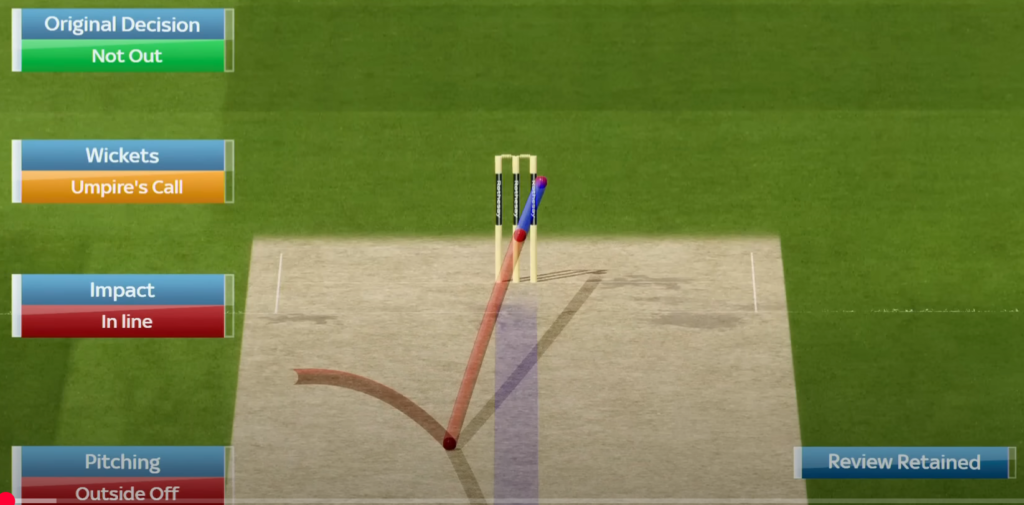
The Wicket Zone is the final stage of the DRS process and predicts whether the ball would have gone on to hit the stumps after striking the batter. It is a two-dimensional area covering the full width of the stumps—from the outside edge of off stump to the outside edge of leg stump—and vertically from the base of the stumps to the top of the bails. If ball tracking predicts that less than 50% of the ball is projected to hit the stumps, the decision falls under umpire’s call. This is one of the most debated aspects of umpire’s call in cricket, as many close LBW decisions are ultimately decided within this zone.
When Is Umpire’s Call Given?
One of the most common questions among cricket fans is when umpire call is given during a DRS review. An umpire’s call in cricket is only applied when the available evidence falls within the predefined margin of uncertainty. This usually occurs in the Impact Zone or Wicket Zone, where ball-tracking technology predicts the ball’s path rather than measuring it with complete certainty. It does not apply to the Pitching Zone, where the point of pitching can be determined accurately.
Why Do Fans Have Conflicting Views On Umpire’s Call?
Many innocent cricket fans think that if the ball goes on to hit the stumps, then a decision must be made in favor of the bowling side. But what they do not take into account is the fine margin of error and the technological limitations surrounding the umpire’s call in cricket.
As Nasser Hussain in the above video points out, it’s never really a question of the cricket ball hitting the stumps. In reality, the ball has never gone on to hit the stumps. The technology makes a predictive assessment of the cricket ball path upon impact, which at times can be inaccurate. Hussain goes on to explain that the DRS technology has its own range of errors, which only predicts that the ball might have gone on to hit the stumps.
In other words, the DRS in cricket struggles to accurately predict the ball’s path, especially if it hits less than 50% of the stumps or the pads along the way; in that case, the benefit of the doubt goes to the on-field umpire. So irrespective of the on-field call made, the decision will remain unchanged in a DRS review if either wickets or impact are umpire’s call.
FAQs on Umpire’s Call in Cricket
What is umpire’s call in cricket?
The umpire’s call in cricket is a rule used under DRS to adjudicate close LBW calls where the ball has less than a 50% chance of either impact with the pads or stumps in play.
What is the meaning of umpire’s call in cricket, and why was it introduced?
The meaning of umpire’s call in cricket is that the original on-field decision stands whenever DRS cannot conclusively prove it was incorrect. The rule was introduced to preserve the authority of on-field umpires while allowing technology to correct only clear and obvious mistakes.
What are the three main zones where umpire’s call is applicable under DRS?
Pitching, Impact, and Wickets are the three main zones where umpire’s call in cricket becomes applicable under the DRS rule.
If the stumps are clipping on umpire’s call, will the original not out or out decision be overturned?
No, the on-field decision, whether out or not out, would stand regardless, as there is less than a 50% chance for the ball to hit the stumps.
If the impact of the ball is umpire’s call, will the original not out or out decision be overturned?
No, the on-field decision from the umpire will be upheld even though the ball might have gone on to crash into the stumps.
Is pitching a major point of consideration under umpire’s call?
Pitching of the cricket ball is considered while adjudicating a LBW review under DRS. However, it is not seen as a major source of consideration as far as umpire’s call is concerned. It is the only scenario where ball tracking can say with absolute certainty exactly where the ball has landed, thereby eliminating any scope of further predictions.
Final Thoughts On Umpire’s Call in Cricket
Now that you understand what is umpire’s call in cricket, it becomes easier to appreciate why the rule continues to divide opinions among players and fans alike. Although umpire’s call may occasionally produce frustrating outcomes, it remains an important part of the DRS process by balancing technological assistance with the authority of the on-field umpire. As ball-tracking technology continues to evolve, debates surrounding umpire’s call in cricket are likely to continue, but its core objective of correcting only clear errors while preserving human judgement is unlikely to change.
More Umpiring Tips & Guidelines
No Ball Rules in Cricket Explained: Types, Waist Height Rules & Free-Hit Scenarios
Can a Cricket Ball Bounce Twice? Double Bounce No Ball Rules Explained

Cricket Rain Delay Rules: Over Calculation Sheet Explained With Examples
Found Our Cricket Coaching Guide Insightful?
With the right equipment, access to top experts, and the resources to grow, Cricvision can go the extra mile! If you’d like to be part of this journey, visit our donation page. Every contribution counts and directly fuels our growth.
Donate Now


One response to “Umpire’s Call in Cricket: DRS Rule Explained”
[…] Furthermore, you must be able to prove your residency in the state you wish to represent as a cricket umpire. You should also be comfortable with basic mathematical calculations, which can come in handy when […]